


Ever Used an App That Just… Froze?
You open an app. It takes forever to load. You tap a button—nothing happens. You try again… and it crashes.
Frustrating, right?
Now imagine thousands of users facing the same issue at the same time. That’s not just a bad experience—it’s lost customers, damaged reputation, and revenue going down the drain.
This is exactly where performance testing comes in.
In today’s fast-paced digital world, apps are expected to be fast, stable, and scalable. And companies are investing heavily to make sure that happens.

What is Performance Testing?
At its core, performance testing checks how well an application performs under different conditions.
In simple terms, it answers questions like:
- How fast does the app respond?
- Can it handle 1,000 users at once?
- What happens when traffic suddenly spikes?
Real-world examples:
- An e-commerce site crashing during a sale
- A banking app slowing down during peak hours
- A streaming platform buffering endlessly
These issues aren’t random—they’re usually due to poor performance under load.
That’s why companies care. Because speed and reliability directly impact user experience.
Why Performance Testing Matters in 2026
Is performance testing in demand 2026? Short answer: Yes—more than ever.
Here’s why:
- Digital growth is exploding: Every business is now online—from startups to global enterprises.
- Users are impatient: Even a 2–3 second delay can make users leave.
- High scalability needs: Apps must handle sudden traffic spikes (think flash sales, viral content).
Industries where it’s critical:
- E-commerce
- Fintech & banking
- Healthcare systems
- Streaming platforms
- SaaS products
So if you’re wondering “is performance testing in demand 2026”—it’s not just in demand, it’s becoming essential.
Performance Testing vs Automation Testing

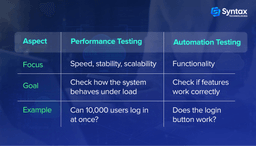
In simple terms:
- Automation testing = Does it work?
- Performance testing = Does it work well under pressure?
Both are important—but they solve different problems.
Performance Testing Tools Comparison
There are several tools out there, but as a beginner, you don’t need to learn everything at once.
Here are some popular ones:
- Apache JMeter: Free, open-source, beginner-friendly
- LoadRunner: Powerful but paid and more complex
- Gatling: Developer-friendly, uses code-based scripts
Why JMeter is a great starting point:
- Easy to learn
- Huge community support
- No cost barrier
- Works well for most basic to intermediate needs
If you’re starting from scratch, JMeter is usually the smartest choice.
Performance Testing Skills for Testers
You don’t need to be an expert coder—but some key skills will really help.
Technical skills:
- Basic understanding of web applications
- Familiarity with tools like JMeter
- Knowledge of APIs and databases
Analytical skills:
- Reading performance reports
- Identifying bottlenecks
- Problem-solving mindset
Bonus skills:
- Basic scripting (nice to have)
- Understanding system architecture
The goal isn’t to know everything—it’s to think logically and analyze behavior.

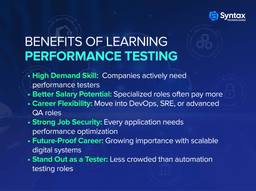
Performance Testing Career Scope
Common roles:
- Performance Test Engineer
- Performance Analyst
- QA Engineer (Performance-focused)
- Site Reliability Engineer (SRE)
Salary trends (approximate):
- Entry-level: $60K–$80K
- Mid-level: $80K–$110K
- Senior roles: $110K+
Future outlook:
The performance testing career scope is expanding as:
- Apps become more complex
- Cloud systems grow
- User expectations increase
This isn’t just a niche skill anymore—it’s becoming a core requirement in software development.
If you’re serious about building job-ready skills, structured learning can give you a clear edge. Programs like the SDET course by Syntax Technologies are designed to help you gain hands-on experience, work on real-world projects, and understand how testing works in actual industry environments.
Conclusion: Why Performance Testing is Worth It
Performance testing ensures apps don’t just work—but work smoothly under pressure. As digital demand grows, this skill is becoming essential for businesses and highly valuable for testers.
For learners, it offers strong career growth, good salary potential, and long-term relevance. Starting with tools like JMeter and building practical skills step by step can quickly put you ahead.
If you’re looking for a future-proof path in testing, performance testing is a smart place to begin.